AI consultant in Melbourne: AI and automation audit
Work out what's worth automating before you buy another tool.
For Australian businesses that have been sold AI but can't see where it pays. As your AI automation consultant, I map how work actually moves through your business, then show you what to automate first, what to leave alone and which tools fit. AI automation consulting that starts with your workflows, not the tools.
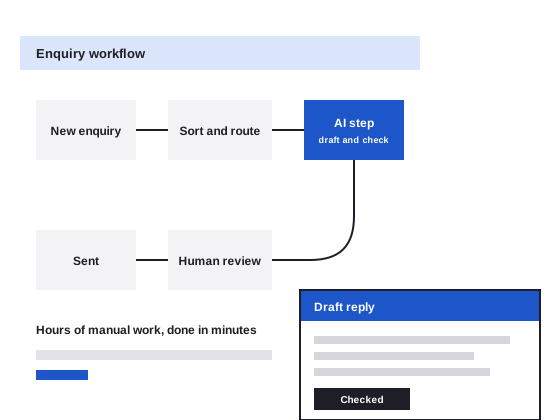
What does an AI consultant do in an AI and automation audit?
An AI consultant works out where AI and automation will save your team real time, and where they won't, before you spend money on tools or builds. My AI and automation audit maps your workflows, ranks the opportunities by hours saved and effort, recommends tools, and gives you a 90-day plan you can act on with or without me. More on the role in what does an AI consultant do?
AI automation consulting: what the audit covers
- A map of your workflows. How work moves between people and systems today, with the hours each step takes.
- A ranked list of what to automate. Every opportunity scored by hours saved against effort and risk, so the first build is the one that pays.
- A build or buy view. For each opportunity: a tool you already pay for, an off-the-shelf product, or a custom workflow, and why.
- The sign-off points. Where a person must check the output before it reaches a customer or your accounts.
- A 90-day plan. What to do first, who does it and what it should cost to run, ready to act on with or without me.
What I look at
Not chatbots on your homepage. The real wins are usually in the repetitive work between your systems.
Check it yourself
Three questions to find your first candidate
- Where do the hours go? Find a task someone spends more than two hours a week on that is really just moving information from one system to another.
- Can you write the steps down? If the task follows “if this, then that” rules, it can probably be automated. If every case needs judgement, it probably can't yet.
- Where must a person sign off? Find the point where someone has to check the work before it reaches a customer or your accounts. That's where the automation pauses and asks.
My own month-end billing works this way: it pulls billable hours from ClickUp, asks me to approve the totals in Slack, then sends the invoice. Nothing goes out without my sign-off.
If you can answer all three for one task, you have a candidate. If you can't, that's what discovery is for. More in what your business can actually automate.
How pricing works
Nothing starts until you've agreed the price.
- A free 20-minute callTell me what's going on. I'll ask about where the hours go, the systems involved and what you need.
- A ballpark by email, when the scope is clearFor most jobs, such as one or two workflows in a small team, I can send a ballpark after the call.
- Paid discovery, when it isn'tIf the work means learning your internal systems and processes, such as workflows that run across your CRM, ERP and finance tools, it starts with a paid 2-hour discovery session. You get a fixed quote for the audit, and the fee comes off it if you go ahead within 60 days.
How it works
- Day 1A 20-minute callFree. Where the hours go, what you've tried, and whether an audit is worth it.
- Stage 1DiscoveryTwo hours, in person in Melbourne or on a video call. I map your main workflows with you and agree the scope.
- Stage 2The audit2 to 4 weeks. I map each workflow with the people who do the work, measure the hours and test what your systems allow.
- DeliveryYour planRanked opportunities, tool recommendations and a 90-day plan, walked through on a call. Build it yourselves, with me or with someone else.
Case study · Large residential home builder
At a large residential home builder, I automated floorplan preparation, cutting each one from 30 minutes to seconds. The publishing integrations I led save 30 minutes on every house-and-land package and 2 hours on every home design.
Read the case studyCommon questions
How much does an AI consultant cost in Australia?
It depends on how many workflows are in scope and how many systems they run across. After a free 20-minute call I can usually send a ballpark by email. Complex work starts with a 2-hour paid discovery session, credited against the audit if you go ahead within 60 days. Building the automations is quoted separately.
AI consultant or AI automation agency: which do I need?
A consultant first, if you don't yet know what to automate. An agency once you know exactly what to build. Agencies are paid to build, so they tend to recommend a build. I'm paid to work out what's worth doing, and sometimes the answer is a process fix, not a model.
What can AI automate in a mid-sized business?
Reliably today: moving data between systems, first drafts, sorting and routing enquiries, cleaning up messy records and assembling reports, with a person checking the output. Not reliably: anything that needs judgement you wouldn't hand a new starter in their first week.
n8n, Zapier or Make: which should we use?
Whichever fits the workflow, your budget and who will look after it. Zapier is quickest for a few simple workflows. Make handles complex logic without you running a server. n8n suits teams that are scaling up, adding AI steps or keeping data on their own infrastructure, and it's what I use for my own work. I compare them in n8n vs Zapier vs Make.
Do you build the automations as well?
Yes, for focused jobs such as n8n workflows and integrations between your systems, quoted separately after the audit. For bigger builds I write the brief and oversee the team doing it. If I could do the work, with Keal Collective on a larger job, I'll tell you up front so you can choose freely.
How long does it take?
Discovery is one 2-hour session. The audit takes 2 to 4 weeks, depending on how many workflows are in scope.
Do you work with businesses outside Melbourne?
Yes. I'm based in Melbourne and work with businesses across Australia and New Zealand. Discovery can be in person in Melbourne or on a video call.

Want to know what's worth automating?
Book a 20-minute call and tell me where the hours go. No pitch, no obligation.
Book a 20-minute call or send me a message. I answer both myself.