For businesses
Website Health Check
You can feel something's wrong with your website. You just can't prove it, and without evidence, you can't justify the spend to fix it.
Traffic has plateaued. Form submissions are lower than they should be. The design looks dated next to competitors. Something is off, but you don't have the internal expertise to point at it and say that's the problem.
A website health check gives you the evidence. One report. One recorded walkthrough. Clear priorities, ranked by impact and effort.
Why this exists
Why this service exists
Most mid-market businesses know their website is underperforming long before they can prove it. The conversation stalls because nobody on the inside has the breadth to point at the specific problem with evidence, and external agencies tend to scope around what they sell rather than what you need.
A health check exists to give you that evidence. Not a sales pitch dressed as an audit. A report you can act on, or take to whichever vendor you choose.
What I bring
Receipts and credentials
Twenty years across both sides of digital delivery. I have led website rebuilds as the senior client-side owner and run them as the delivery agency. I have audited sites where the design was the problem, sites where the analytics were the problem, and sites where the only real problem was that nobody had stopped to ask whether the thing was working.
The breadth matters here: one operator covering design, performance, SEO, analytics, content, and conversion. Not a relay of specialists each protecting their patch.
What the health check covers
- Design and UX Layout, hierarchy, readability, mobile behaviour, accessibility basics.
- Performance Page speed, Core Web Vitals, image handling, render-blocking resources.
- On-page SEO Crawlability, indexation, structured data, internal linking, canonical handling, schema markup, content optimisation.
- Off-page SEO Keyword visibility, ranking patterns, competitor coverage, search opportunity gaps.
- Conversion paths Forms, CTAs, journey friction, exit points.
- Analytics setup Whether GA4 and GTM are actually measuring what you think they are.
- CMS and integrations Content governance, editor experience, integration reliability. Most audits cover one of these. A pure SEO agency won't flag a broken conversion path. A pure designer won't flag a misconfigured GA4 event. This covers all of it because one generalist is doing the work, not a relay of specialists.
What this looks like in practice
At a large residential homebuilder I ran weekly technical SEO audits across the platform and managed the SEO vendor relationship. The platform re-build itself, informed by the same diagnostic lens, delivered a 75% conversion rate uplift post-launch. That came from improved UX, information architecture, and content structure. Not A/B testing. Not dark patterns. Fixing the things that were quietly costing conversions.
The design background is why this audit is different. I see what developers miss, and I can read the code well enough to know whether a fix is a 30-minute change or a 3-week project.
Tools and platforms
- GA4 for traffic and conversion analysis.
- Google Tag Manager for event tracking and tag governance.
- Search Console for indexation, crawl issues, and Core Web Vitals.
- Lighthouse for performance and Core Web Vitals benchmarking.
- Screaming Frog for technical SEO crawling.
- Mangools for keyword research, ranking analysis, and competitor coverage.
- Hotjar for behaviour and conversion-friction analysis.
- CMS depth across WordPress, Craft CMS, Shopify, and SharePoint.
What you get
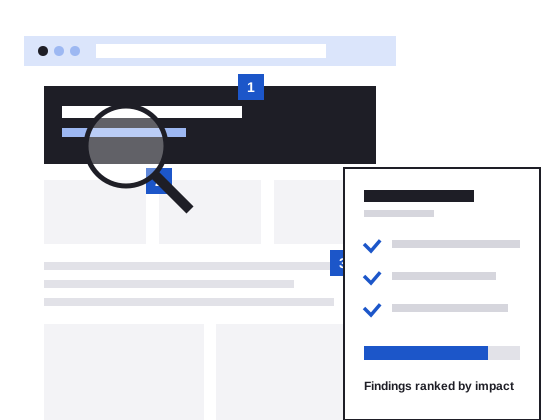
- A written report covering every area above, with findings ranked by impact and effort
- A recorded video walkthrough of the findings. Easier to share internally than a PDF alone, and the context doesn't get lost in translation to your stakeholders.
- A prioritised list of next steps, grouped by what you can fix in-house versus what needs a vendor
Frequently asked questions
-
How much does a website health check cost?
$1,500 for a standard mid-market site. Larger estates, multi-brand setups, or heavy e-commerce are scoped on enquiry. The price is published because the scope is fixed: you know what you're buying before the call.
-
How is this different from a $500 SEO audit?
A $500 audit is usually a single-lens report: SEO findings, generated largely by software, ending in a list of errors. The health check is a human diagnostic across design, performance, technical SEO, conversion, analytics, and CMS operations, ending in a prioritised roadmap that separates 30-minute fixes from 3-week projects. If you already know exactly where the problem is, a specialist audit is fine. If you don't, a narrow audit finds what it was built to find.
-
How long does it take?
Most health checks are delivered within 7 to 10 business days of sign-off, with a written proposal within two business days of the discovery call.
-
What do I actually receive?
A written report with evidence for every finding, an impact assessment, and a prioritised action list grouped by what your team can fix in-house versus what needs a vendor. Plus a walkthrough call to take you through it.
-
Will you try to sell me a rebuild afterwards?
No. The health check exists to tell you the truth about the site you have. If the honest answer is "this site is fine, fix these five things", that's the report you get. Rebuild recommendations only appear when the evidence supports them, and the reasoning is shown.
-
Can you run the fixes too?
Yes, in two ways: your team or incumbent vendor works from the roadmap, or I stay involved through a Digital Advisory engagement to own delivery. The report is written so either path works.
Pricing
Pricing
- Standard. $1,500. Covers most mid-market sites.
- Complex. Scoped on enquiry. Larger sites, multi-brand setups, multiple integrations, or heavy e-commerce.
Next
What happens next
A 20-minute discovery call to confirm fit. A written proposal within two business days. Most health checks are delivered within 7 to 10 business days of sign-off.
The health check is often where longer engagements start. Once the findings are in, most clients want the same person to own the fix, either as a standalone project or as a fractional retainer.