B2B ecommerce development: Shopify, PIM, ERP and dealer portals
Ecommerce that runs the business, not just the shopfront.
For Australian distributors and wholesalers whose online store has to work with their product data, trade pricing and stock systems. I plan the platform, lead the integration work and build the store, with vetted senior developers from Keal Collective on the biggest builds.
 You'll work with me, AnthonyNot an account manager or a junior. I reply to every enquiry myself.
What is B2B ecommerce development?
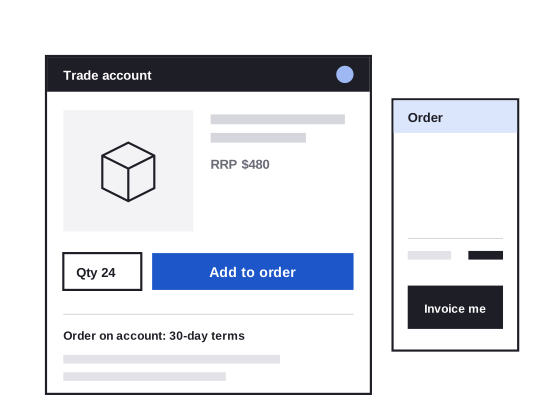
Building the online store, trade portal and integrations a business needs to sell to other businesses: account pricing, bulk and repeat ordering, and stock and orders flowing to and from the ERP. For distributors and wholesalers, done well, it takes work off the team instead of adding to it.
In progress · National distributor
Taking over a stalled platform build
A national distributor's platform build had lost momentum. They brought me in client side as head of digital delivery. I re-planned the architecture and now lead the rebuild in phases, product data first.
- One home for product data. A PIM owns everything customer-facing. The ERP stays the system of record for operational data. No field is managed in two places.
- A new public website. Fed from the PIM, with fast product search across the full range.
- A dealer portal. Dealers find products, pricing and documents themselves instead of calling the office.
- Retail stores on the same data. A Shopify brand store connected to the same product source, so products are updated once.
A full case study will follow once the platform is live and the client has signed off on sharing it.
What I do
Shopify launches fast. Where B2B projects go wrong is the integration work nobody scoped properly.
Shopify B2B or Craft Commerce?
Both can run trade ordering. The right one depends on your products and how you sell.
| Compared on | Shopify B2B | Craft Commerce |
|---|---|---|
| Best for | Retail and trade from one store, using standard B2B features | Products that need rich content, complex configuration or tight links to the rest of your site |
| Hosting | Hosted by Shopify | Hosted on your own or managed servers |
| Watch for | B2B features vary by Shopify plan, so check yours before you commit | More build work up front, and someone has to look after it |
How it works
Every build is quoted at a fixed price once the scope is locked.
- FreeA call about how you sellHow products, prices and orders move through your business today, and where the time goes.
- ScopingWhat to build, and in what orderPaid scoping: the platform, the integrations, the phases and a budget, before anyone writes code.
- The buildA fixed price, in phasesProduct data first, then the website, portal and stores on top of it.
- After launchI stay onFor as long as it's useful: improvements, support and the next phase.
From the field · Ecommerce and ERP integration
Before this, I led store-to-ERP integrations for distributors and a high-volume online grocer: product catalogues, pricing, stock and orders, scoped and delivered between the client's IT team and the developers.
Common questions
How much does B2B ecommerce development cost?
It's quoted at a fixed price once the scope is locked, because a trade store on Shopify and a PIM, dealer portal and ERP integration are very different jobs. Most projects start with scoping, from $3,500 ex GST, credited against the build. If a build has stalled, start with an independent assessment, $1,500 to $2,500 ex GST.
Can Shopify do B2B?
Yes, with limits. Shopify has built-in B2B features such as company accounts, trade price lists and payment terms, but what you get depends on your plan, and complex pricing or approval rules can need custom work. I check that against how you actually sell before you commit.
Do you build Shopify stores yourself?
Yes: native themes, custom themes or headless. I'm a Shopify Partner, and vetted senior developers from Keal Collective join me on the toughest builds. More on how I build on Shopify.
What is a PIM, and do we need one?
A product information management system holds your product content in one place and feeds every channel. You probably need one if you sell the same range across a website, a store, dealers or marketplaces, and keep updating products in several places.
PIM or ERP, what's the difference?
The ERP runs the business: stock, pricing, orders and invoices. The PIM holds the product content customers see: descriptions, images, specs and documents. Most distributors need the ERP to stay the system of record and the PIM to feed every channel, with no field managed in both.
What is a dealer portal?
A logged-in area where your dealers or trade customers find products, their own pricing and documents, and order for themselves instead of calling the office.
Can you take over an ecommerce project from another agency?
Yes. I start with a project rescue assessment: an independent read on where it really is, then a plan to finish it, with the same agency or a new one.

Is your store creating more work than it saves?
Tell me how products, orders and pricing move through your business today. I'll tell you where the time is going.
Call me on 0466 977 253 or send me a message. I answer both myself.
Bigger project? I bring in Keal Collective, vetted people I work with, and stay your lead.